
Labour MPs have raised concerns with the Home Office over the way settlement applications by Turkish businesspeople who established businesses in the UK under the Ankara Agreement are being handled, citing incorrect refusals, lengthy delays and what they describe as an increasingly strict decision-making process.
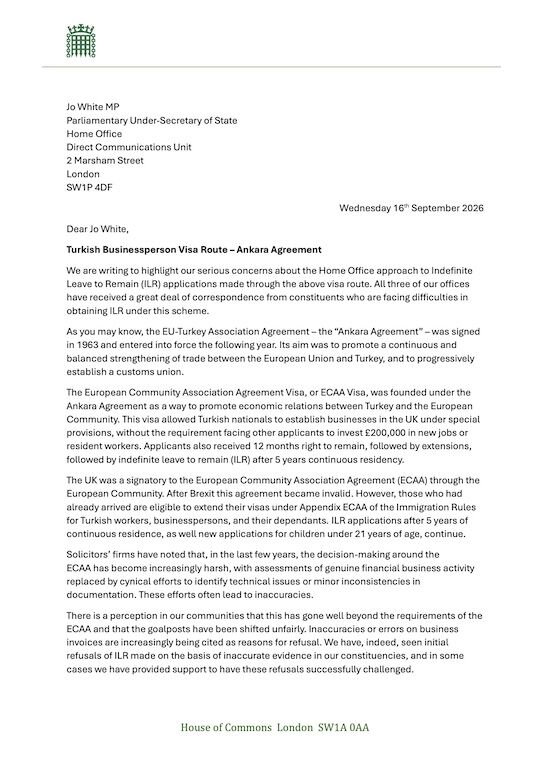
Labour MPs Bambos Charalambous, Feryal Clark and David Lammy have taken serious concerns about the assessment of settlement applications under the Turkish Businessperson route to the Home Office.
In a joint letter to Home Secretary Jo White, the three MPs said applicants under the Turkish Businessperson Visa route were facing lengthy delays, administrative errors and an increasingly rigid approach to decision-making.
The MPs noted that, following Brexit, the Ankara Agreement route was closed to new applications. However, Turkish nationals who came to the UK under the scheme before Brexit continue to have rights to extend their visas and apply for settlement after five years of continuous residence, subject to the applicable requirements.
“The way applications are being assessed has changed”
The MPs said in their letter that they had received complaints from a large number of Turkish businesspeople living in their constituencies about applications made under the Ankara Agreement.
According to information received from lawyers and applicants, technical issues or minor inconsistencies in documents are increasingly being used as grounds for refusal, rather than focusing on whether businesses are genuine and actively trading.
The MPs said simple errors on business invoices and similar technical issues were increasingly being cited as reasons for refusal, adding that this had created a strong perception among applicants that “the rules are being unfairly changed”.
Home Office errors raised
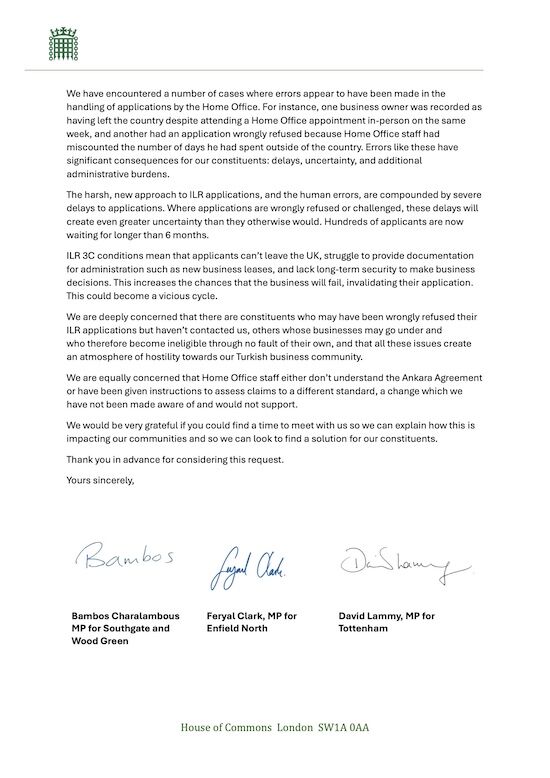
The joint letter also referred to several specific cases in which Home Office officials were believed to have made mistakes.

In one case, an applicant who attended an in-person Home Office appointment during the same week was reportedly incorrectly recorded as having left the UK.
In another case, an application was refused because officials allegedly miscalculated the number of days the applicant had spent outside the country.
The MPs stressed that such errors were causing lengthy delays, significant uncertainty and additional administrative burdens for applicants and their businesses. The letter also stated that some incorrect refusals had been successfully challenged following intervention by MPs.
Hundreds have been waiting for more than six months
According to the letter, hundreds of applicants have been waiting for more than six months for their settlement applications to be decided.
Those whose lawful status continues under Section 3C of the Immigration Act while their applications are being considered are also facing significant practical difficulties. They may be unable to travel abroad, face difficulties securing new business premises and lack the certainty needed to make long-term investment decisions.
The MPs warned that this uncertainty could weaken businesses and potentially put applicants’ ability to secure settlement at risk.
The letter said delays in the decision-making process could negatively affect a business, while the resulting weakness in the business could subsequently be used against the applicant, creating a “vicious cycle”.
Concerns over the treatment of the Turkish business community
The three MPs also expressed concern that some people whose settlement applications had been unfairly refused may not have sought help from their MP or been able to challenge the decision.
The letter warned that the Home Office’s current approach was creating an “atmosphere of hostility” towards the Turkish business community in the UK.
The MPs wrote:
“We are equally concerned that Home Office staff may not understand the Ankara Agreement sufficiently, or that they may have been instructed to assess applications against a different standard. We have not been informed of any such change and we do not support it.”
Bambos Charalambous, Feryal Clark and David Lammy have asked Home Secretary Jo White for a meeting to discuss the problems and find solutions for affected applicants.
The Ankara Agreement after Brexit
Signed in 1963, the Ankara Agreement was intended to strengthen economic relations between Turkey and the European Economic Community.
Under the European Community Association Agreement (ECAA), Turkish nationals were able to establish businesses in the UK under specific provisions and, after completing the required period of lawful residence, apply for settlement.
Following Brexit, the route was closed to new applications. However, transitional arrangements continue to apply to people who came to the UK under the Ankara Agreement before the system was closed.
The joint initiative by the three MPs increases pressure on the Home Office to clarify whether its approach to settlement applications under the Ankara Agreement has changed.
The MPs are also calling for action to ensure that Turkish entrepreneurs who have built businesses and new lives in Britain over many years are not unfairly disadvantaged by administrative errors and lengthy delays.